Russia’s national goals for 2030 and 2036 — where is Russia heading?
For anyone considering a move to Russia, it helps to see where the country is going.
On inauguration day, the president signed his first decree of the new term. It sets the national development goals through 2030, with a horizon to 2036. The decree is about ten pages. What follows is a full reading of each goal.

Seven focus areas
Preserve the population, strengthen health and well-being, and support the family.
Develop each person’s talents, and raise a patriotic, socially responsible character.
A comfortable and safe place to live.
Ecological well-being.
A sustainable and dynamic economy.
Technological leadership.
Digital transformation of government, the economy, and the social sphere.
What stands out
A few figures carry the document. The tables further down keep every target.
4th in the world
By purchasing-power parity no later than 2030, ahead of Japan.
33 m², then 38 m²
Housing per person by 2030 and 2036. The stock is to grow about 15% and then 30%.
50% built in Russia
Share of civil aircraft in Russian airline fleets that are domestically made.
Domestic software
Government bodies, and most key industrial firms, move onto Russian software.
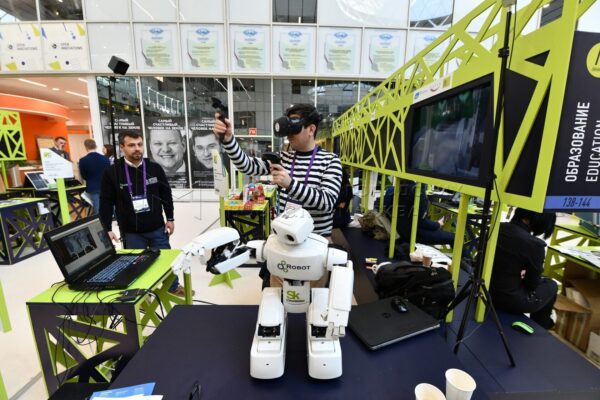
Top 25 in robotics
Alongside higher spending on research and digitalization across the economy.
Poverty under 7%, then 5%
By 2030 and 2036, with a stronger middle class and a narrower income gap.
In short, this is an industrial plan: diversify the economy and insulate it from sanctions, while growing the population and raising the income and well-being of the middle class.
1. Demographics
National goal: preservation of the population, stronger health and well-being, and support for the family.
Healthy life expectancy is to rise faster than life expectancy overall, and the birth rate for third and later children is to rise every year.

| Target | 2030 | 2036 |
|---|---|---|
| Total fertility rate | 1.6 | 1.8 |
| Life expectancy | 78 years | 81 years |
| Poverty | Below 7% | Below 5% |
| Poverty among large families | 12% | 8% |
| Gini coefficient (income concentration) | 0.37 | 0.33 |
| Minimum wage | At least 35,000 rubles a month, more than double the 2023 level | — |
Other targets in this goal:
- Regions. By 2030, regions whose fertility in 2023 was below the Russian average raise it at least as fast as the national average.
- Regional gap in life expectancy. By 2036, at least 25% smaller than in 2023.
- Sick leave. By 2030, fewer days of temporary disability among working-age people, through healthier living, earlier prevention, and regular sport.
- Long-term care. By 2030, services for at least 500,000 elderly and disabled people who need them most.
- Veterans of the special military operation. By 2030, higher satisfaction with medical rehabilitation, retraining, and employment.
- Digital health. By 2030, a platform that helps people build and keep their health through life, run on data.
- Public-sector pay. New wage systems for state and municipal staff approved in 2026 and in force from 2027, so budget-sector incomes rise as set out in the presidential decrees of 7 May 2012 No. 597, 1 June 2012 No. 761, and 28 December 2012 No. 1688.
2. Individual
Realizing each person’s potential, developing their talents, and nurturing a patriotic and socially responsible personality.
| Target | 2030 | 2036 |
|---|---|---|
| Foreign students at Russian universities and research institutes | At least 500,000 | — |
| Young people in professional, personal-development, and patriotic programs | At least 75% | — |
| Young people who believe they can fulfill themselves in Russia | At least 85% | — |
| Young people in volunteer and public activity | At least 45% | — |
| Students covered by talent identification, support, and career guidance | 100% | — |
| State-funded culture, arts, and folk projects that promote traditional Russian values | At least 70% | At least 80% |
| Teaching staff in annual further training on updated professional standards | At least 10% | — |
The same goal also sets three conditions, all by 2030:
- An upbringing of a harmoniously developed, patriotic, and socially responsible person, based on traditional Russian spiritual, moral, and cultural-historical values.
- A talent system built on responsibility, fairness, and access for everyone, aimed at self-determination and career guidance.
- Higher public satisfaction with state and municipal organizations of culture, art, and folk creativity.

3. Comfort and safety
A comfortable and safe living environment. The 33 m² and 38 m² norms are what the highlights turn into a 15% and 30% rise in the housing stock. The decree itself also requires the stock to be renewed by at least 20% from the 2019 level by 2030.
| Target | 2030 | 2036 |
|---|---|---|
| Quality of living conditions in key settlements | +30% | +60% |
| Housing per person | At least 33 m² | At least 38 m² |
| Housing stock renewed vs 2019 | At least 20% | — |
| Households connected to the gas network | At least 1.6 million | At least 3 million |
| Deaths in road accidents vs 2023 | 1.5 times lower | 2 times lower |
Infrastructure and transport, by 2030:
| Target | By 2030 |
|---|---|
| Public spaces developed | At least 30,000 |
| Winning projects for a comfortable urban environment in small towns and historic settlements | At least 1,600 |
| People covered by modernized municipal infrastructure and better municipal services | 20 million |
| Drinking-water supply and treatment facilities built or rebuilt | At least 2,000 |
| Public transport in cities and agglomerations still within its standard service life | At least 85% |
| Federal highways and roads in major urban agglomerations that meet standards | At least 85% |
| Roads of the support network that meet standards | At least 85% |
| Regional and inter-municipal roads that meet standards | At least 60% |
| Aviation mobility of the population vs 2023 | At least +50% |
| Aircraft in Russian airline fleets that are domestically produced | At least 50% |
| Centers for Russian film in settlements of up to 50,000 people, on one digital platform | Up to 900 |
| Major renovation of preschool and school buildings that needed it on 1 January 2025 | Finished by the end of 2030 |
Three further commitments have no numeric target:
- A steady fall in the share of housing that is unfit to live in.
- More housing available on the primary market.
- A clear gain in energy and resource efficiency in housing and utilities, and in industrial and infrastructure construction.

4. Ecology
Ecological well-being.
| Target | When |
|---|---|
| Sort 100% of the municipal solid waste produced each year, landfill no more than 50% of it, and return at least 25% of production and consumption waste to the economy as secondary raw material | 2030 |
| Eliminate at least 50 hazardous sites of accumulated environmental damage | End of 2030 |
| Cut in half the most harmful pollutant emissions in cities with high and very high air pollution | 2036 |
| Utilize or neutralize at least 50% of Class I and Class II hazardous waste | 2036 |
| Cut in half the untreated wastewater discharged into major water bodies, and preserve Lake Baikal | 2036 |
- Conserve forests and biodiversity.
- Develop specially protected natural areas in a sustainable way.
- Make ecological tourism possible in every national park.
5. Economy
A sustainable and dynamic economy. Growth is to stay above the world average, with stable macroeconomics, low unemployment, and less structural unemployment. Real incomes and pensions are to rise at least in line with inflation. From 2024 to 2030, real income per worker in small and medium-sized enterprises is to grow 1.2 times as fast as GDP.
| Target | 2030 | 2036 |
|---|---|---|
| Place in the world by GDP at purchasing-power parity | 4th | — |
| Imports of goods and services, share of GDP | 17% | — |
| Investment in fixed capital vs 2020 | At least +60% | — |
| Stock-market capitalization, share of GDP | At least 66% | 75% |
| Long-term savings, share of household savings | At least 40% | 45% |
| Robot density | Top 25 countries | — |
| Medium and large firms in basic non-resource sectors taking part in productivity projects | At least 40% | — |
| State and municipal social-sector organizations in those projects | 100% | — |
| Vocational students able to take more than one qualification | At least 30% | — |
| Tourism, share of GDP | 5% | — |
| Exports of non-resource, non-energy goods vs 2023 | At least two-thirds higher | — |
| Agro-industrial output vs 2021 | At least +25% | — |
| Agro-industrial exports vs 2021 | At least 1.5 times | — |
| Exports of tourist services vs 2023 | 3 times | — |
| Freight on international transport corridors vs 2021 | At least 1.5 times | — |
| Gap in budget funding between the 10 best-funded and 10 least-funded regions, counting targeted federal transfers | — | No more than double |
The decree also calls for:
- By 2030, training and retraining for priority sectors, based on a forecast of what those sectors need.
- By 2030, a way for people already in work to keep learning, including a new profession.
- A network of partnerships abroad, with the infrastructure for trade, technology, and industrial cooperation, and with new markets.
- A larger share of creative industries in the economy.
- Climate-adaptation programs at federal, regional, and company level.
- A national system for monitoring climate-active substances.
6. Technology
Technological leadership: independence in critical fields, and new markets built at home.
The new markets named in the decree:
- Bioeconomy and health
- Food security
- Unmanned aircraft
- Machine tools and industrial automation
- Transport mobility, including autonomous vehicles
- The data economy, digital transformation, and artificial intelligence
- New materials and chemistry
- Promising space technologies and services
- New energy, including nuclear
| Target | By 2030 |
|---|---|
| Manufacturing value added, and the industrial production index, in real terms vs 2022 | At least +40% |
| Rank by volume of research and development | Top 10 in the world |
| Domestic spending on research and development | At least 2% of GDP, with private investment in R&D doubled |
| Share of domestic high-tech goods and services, built on Russia’s own development lines, in total consumption of such goods vs 2023 | 1.5 times |
| Revenue of small technology companies vs 2023 | At least 7 times |

7. Digitalization
Digital transformation of state and municipal government, the economy, and the social sphere.
From 2025 to 2030, investment in domestic IT solutions is to grow at twice the rate of GDP.
| Target | 2030 | 2036 |
|---|---|---|
| Households with high-quality high-speed broadband, including satellite and mobile, with more capacity | 97% | 99% |
| Organizations in key sectors using Russian basic and applied software for their main production and management systems | At least 80% | — |
| Russian software in state bodies, state corporations, state companies, companies majority-owned by the state, and their affiliates | 95% | — |
| Mass socially significant state and municipal services provided online | 99% | — |
| Citizen satisfaction with state and municipal officials and with social-sector staff | At least 50% higher | — |
Alongside the numbers, the decree sets these tasks:
- By 2030, “digital maturity” in government, key industries, and the social sphere, including healthcare and education. Most transactions run on shared industry platforms. Decisions use data, large-scale data processing, machine learning, and artificial intelligence.
- A data market: data stored, exchanged, protected, and put to work in the economy.
- At least 100 mass state services with a decision-support system, delivered proactively or on request, through one digital platform used by public authorities.
- Selection, development, and rotation of officials on equal opportunity and professional qualifications, with regular assessment and feedback on that platform.
- A working system against crimes committed with information and telecom technology, and less damage from those crimes.
- Network sovereignty and information security on the internet.
Next steps
1 September 2024. The government sets targets for the further areas listed below.
1 January 2025. A full plan for reaching every goal is prepared and submitted for approval.

- A long and active life
- Family
- Youth and children
- Talent
- Infrastructure for life
- An efficient transport system
- Environmental well-being
- An efficient and competitive economy
- Tourism and hospitality
- International cooperation and export
- The data economy and digital transformation of the state